

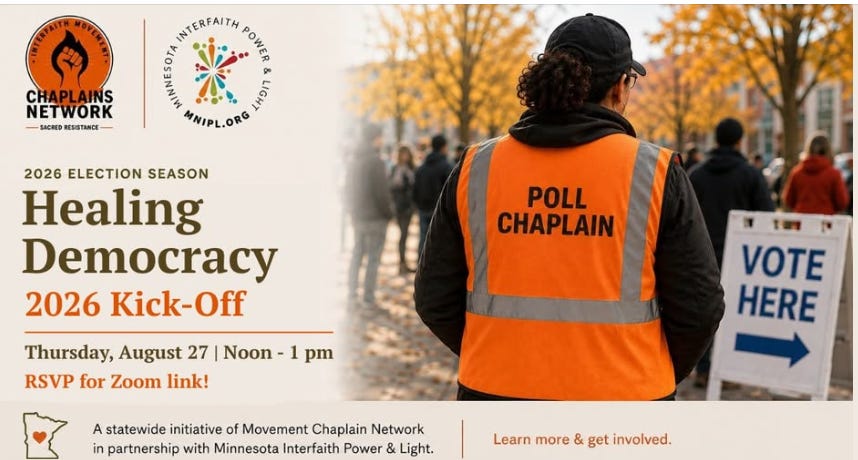
In this interview with Ben Connelly, a member of the coordinating committee of Multifaith Anti-Racism Change and Healing and a guiding teacher at the Minnesota Zen Meditation Center, we discussed the Healing Democracy effort and its goals. The project is a statewide initiative of the Movement Chaplain Network, in partnership with Minnesota Interfaith Power & Light, to provide a calm presence on Election Day.
Many Better Minneapolis interviews focus on policy positions. Here, we discuss why we vote in a broader sense. As Connelly says at the start, “Democracy is about having a culture where we trust each other, where we care about each other, and agree to make decisions together.” Framing an election this way, as an expression of care for our community, softens the edges of the sharp attacks often aimed at people with opposing views. There must be space where we can sit with the opinions of others and avoid the attacking crouch that often becomes our default posture.
“It’s sad. I would much rather be doing something else with my time than investing a lot of energy and just ensuring that people can safely vote in the United States. But that’s where we are,” Connelly said.
Healing Democracy exists because people of many faiths are concerned that federal agents will disrupt the election. To help ease fears in the community, volunteers will be out on Election Day wearing vests that say “Poll Chaplain.”
Connelly explains their role with the example of a bar fight. If you want to separate two people who are about to come to blows, you can’t do it by adding your own aggressive energy to the mix. You need to bring a calm presence that de-escalates the situation. Being that calm presence takes training and preparation. We are all vulnerable to being hijacked by our base selves, so awareness of our motivations and impulses has to be developed.
While the possibility of physical intimidation on Election Day has received a great deal of attention, social media is another place where unhelpful speech spreads. “Don’t feed the trolls. It’s pretty obvious, arguing with people online is not generally helpful,” Connelly said.
Most of us recognize the downsides of social media, yet it continues to thrive and drive discussion. Connelly stresses that whether and how we participate is a choice. Social media can foster understanding and communication. Creating, liking and reposting the most incendiary content has the opposite effect. “Develop a practice and a discipline about just putting it down,” Connelly said.

Candles on Corners and Online Healing Sessions
There is a great deal of anxiety and enthusiasm around this midterm election. Voting is an important way to express concern for your neighborhood and city.
Healing Democracy is also encouraging people to take part in Candles on Corners. Starting on Election Day, participants light a candle at 7 p.m., then go to a corner and join neighbors in a simple show of mutual respect and care. Organizers encourage people to keep returning to the corner each Tuesday until the new Congress is sworn in.
Healing Democracy is also hosting virtual healing sessions at luma.com/healingdemocracy. The first is Monday, Nov. 2, at 8:30 p.m. You can join on Election Day starting at 8 p.m. Check the Healing Democracy event page for more information.
During Operation Metro Surge, Minneapolis showed the world the power of mutual aid and how standing with our neighbors can inspire change and empowerment. Voting is an extension of that movement.
“We collectively make the soil from which our liberation can grow. And this is like a little stalk. Healing democracy,” Connelly said.


