


On Tuesday morning, Leticia Cardenas, Assistant Director of Minneapolis 911, presented her department’s financial overview to the City Council Budget Committee. Every department goes through this exercise so the council can see where spending is rising, falling, or needs to be redirected.

The Minneapolis Emergency Communications Center (MECC) includes the 911 call center and the Radio Shop. Its budget is increasing by $1.5 million, to $16.5 million. Most of that increase comes from salaries and fringe benefits, which are rising by 20%. With 92 employees, that works out to an average cost of $142,016 per employee.
Several factors appear to be driving up employee costs, including the overtime needed to meet basic standards for 911 call centers. Council Members Shaffer and Palmisano questioned Cardenas after she reported that 41% of staff are currently out on Paid Family and Medical Leave (PFML). Because the center must cover every shift, 24 hours a day, 365 days a year, burnout and turnover are significant, and the problem is difficult to fix. The state legislature passed the law requiring employers to offer 12 weeks of paid leave, which employees can take as soon as they are hired. Cardenas did not know at what rate the state would reimburse her department for employees on leave. Training a new operator takes three to eight months, so the department regularly hires above its budgeted 84 positions, expecting that some people will quit or take leave.
What Is Your Preferred Safety Statistic?
Whenever we publish a story about crime in the city, readers criticize the statistics. The most vocal are often those who argue that crime is down. On that point, the Star Tribune recently reported that Minneapolis homicides fell 27% through September 2026 compared with the same period in 2025, and the number of gunshot victims has dropped below 2019 pre-pandemic levels. At the same time, vehicle thefts, other thefts, and car window break-ins have increased, frustrating residents and business owners even as violent crime declines.
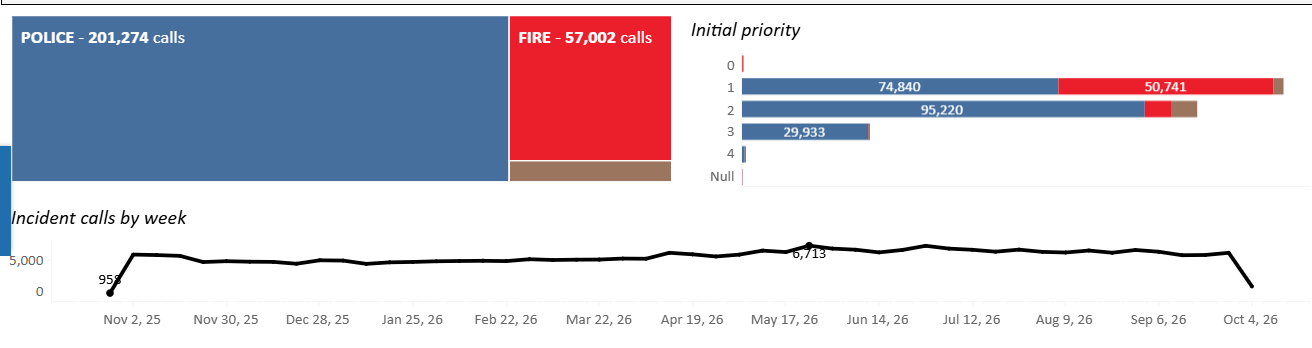
We find 911 call data to be a useful indicator of whether crime is rising or falling, and call volume has been steady. Over the past 12 months, the center received 266,848 calls. About 75% were routed to MPD, and of those, 37% (74,840 calls) were classified as Priority 1. These are calls that “represent serious emergencies with an imminent threat to personal safety or severe potential for property damage where conditions at the scene are volatile.” That is more than 200 Priority 1 calls a day, handled by a call center with 41% of its staff on leave. The center receives between 5,000 and 7,000 calls each week. Given that workload, it is easy to see why so many shifts are covered with overtime. The same volume may also help explain the overtime paid to MPD patrol officers who respond to these calls.
Calls directed to the Behavioral Crisis Response (BCR) team make up about 3% of the total: 8,572 of 266,848 over the past 12 months. So far, the service has had only a small effect on the police and operator hours needed to provide public safety. The city plans to change BCR vendors, moving from Canopy Roots, a local Black-owned company, to Community Bridges, based in Arizona. The new contract is valued at $5.9 million and runs through December 2028. Canopy Roots has been paid just over $26 million since it began in 2021.

Uptown Is Still Waiting for Community Safety Ambassadors
Business owners in Uptown continue to report break-ins, vandalism, and graffiti. Repairs often cost between $500 and $2,000. Because those amounts fall within insurance deductibles, owners pay out of pocket. When these incidents happen often enough, the costs add up, especially while customers have been slow to return to the area. Many owners feel the city does not take their complaints seriously, and some have organized their own walking safety groups. This is frustrating given that the city is budgeting $2,276,694 toward having 23 in-house Community Safety Ambassadors (CSAs), or about $99,000 per position.
In her presentation, Neighborhood Safety Director Amanda Harrington said:
“We’re currently hiring for 21 positions. We hope to have staff start October 13th, which is very soon, and have them go through an intensive two-week training program before going out on the streets in November. This slide shows our projection for staffing three zones, which costs about $2.5 million. This includes about a six-person team on East Lake Street, a four-person team on Franklin Avenue, and an eight-person team in Uptown. Uptown is new, so I want to note the boundaries: Franklin Avenue down Hennepin to 31st Street, and then Lake Street from 35W to East Bde Maka Ska.”
Many council members are skeptical of MPD and expressed frustration that the police budget is increasing while the Neighborhood Safety Department has been asked to absorb an $800,000 cut. Meanwhile, the department’s performance metrics remain a concern. Council Member Warren worried that CSAs would be placed between police and the people responsible for violence. Harrington explained that CSAs are there to call 911 when a situation becomes volatile. Violence Interrupters, by contrast, focus on building relationships within the community.
Harrington also cautioned council members against confusing correlation with causation. In other words, it is too early to conclude that violent crime is down because of these programs. City-sponsored healing circles may be building trust and relationships, but there is no direct evidence that they are reducing gang violence or other violence in the city. A request was made by Council Member Rainville for an accounting of all the vendors who had been paid without supplying proper documentation of their work. A recent audit demonstrated that proper accounting for payments continues to be an issue.
Several council members asked for the programs to be expanded and questioned Harrington about how the zones were chosen. Those questions reflect two assumptions: first, that crime continues to disrupt neighborhoods, and second, that alternatives to traditional policing are an essential part of the public safety system. This budget cycle will reflect the tension between the two. Council members are frustrated that the police budget keeps growing, while the public is growing impatient for results from non-police alternatives.


