


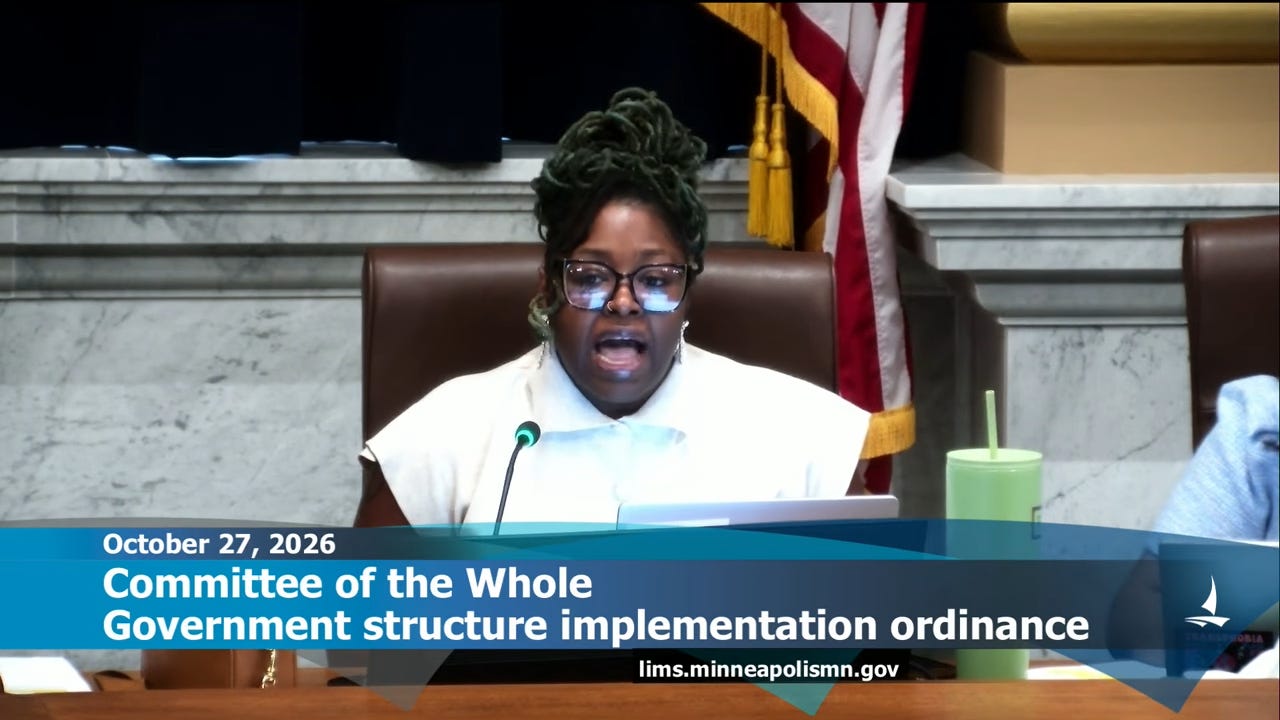
Most of Tuesday’s Committee of the Whole (COW) meeting was spent on a proposal from Council Minority Leader Wonsley, Council President Payne and Vice President Osman to eliminate the Office of Community Safety (OCS). The slide deck Wonsley presented is available in LIMS. The committee voted 9 to 3, with Council Member Shaffer abstaining, to send the proposal to the full council for a vote on Thursday, October 29. Whiting, Palmisano and Rainville voted against it.
As Wonsley walked through the deck, we were reminded of the breakup of cable TV. Under cable, every channel came through one system. Now we have a separate streaming service for everything. In the same way, each department under the OCS (police, fire, emergency management, 911 and neighborhood safety) would become independent and report directly to the mayor. Coordinating among them would be the mayor’s job.
If you’re thinking about running for mayor in two years, this meeting is worth watching. The council is expanding the mayor’s role by removing the commissioner and placing these departments directly under the mayor. Their reasoning is that the OCS never lived up to its purpose, and the police chief routinely bypassed the commissioner to go straight to the mayor. So why pay $375,000 a year to a commissioner who lacked the authority to enforce the chain of command?
The proposal drew an unusually passionate response from Council Member Whiting. “I think this is one of the most reckless pieces of work to come across this body,” he said. His concern comes from his work as the attorney who helped the city comply with the consent decree. The OCS has its flaws, he argued, but the prudent choice would be to fix it. When Wonsley said the office had done nothing to help the individual departments, Whiting pointed out that just five minutes earlier, Neighborhood Safety Department Director Harrington had said the OCS was instrumental in clearing roadblocks.
The power struggle underneath it all
The council may describe the OCS as an expensive and unnecessary layer of bureaucracy. But as with most issues the council takes up, we believe the real motive is to criticize the mayor’s past performance and set up a structure where any future problems with invoicing, vendors, police misconduct or budget overruns land squarely on him. They want no ambiguity about who is responsible.
As the search for the next mayor begins, candidates will be asked how they would manage these departments differently than Frey. That is a fair question. But we suspect many council members see that public confidence in their “public safety ecosystem” is slipping. Rather than admit they rushed to stand up these programs, they want to be able to say the programs would have worked if only the mayor had supported them. In two years, a candidate will say, “I won’t let these programs fail the way Frey did.” The groundwork for that message is being laid now.
Commissioner Barnette was paid more than almost every public employee except P. J. Fleck and his coaching staff. (That’s a joke, but it’s also true.) When you earn that much, people expect a lot. Council Member Stevenson was one of several members who brought up Barnette’s salary, saying, “We have an office that doesn’t have the power to do the thing that it says that it’s supposed to do.”
People expected a commanding performance. They wanted to be impressed. Barnette’s quiet, behind-the-scenes approach didn’t satisfy them. He was expected to lead every press conference as if he ran the city. Instead, former Police Chief O’Hara did most of the talking. The fact that Barnette didn’t learn about MPD’s cost overruns until late in the year convinced many council members that he was an unnecessary figurehead. At times, the council seemed more upset about Barnette’s salary than about how the OCS actually performed.
Whiting wasn’t the only committee member who preferred reform over elimination. “I can get behind the idea that our existing Office of Community Safety needs to change, absolutely, but I am not convinced it should go away completely,” said Palmisano. During public testimony, Justin Terrell of the Minnesota Justice Research Center called the office a “hot mess” but still supported keeping it. “Trust isn’t built through policy on paper,” he said. “It’s built through consistency, radical transparency, shared authority, all things we have been missing.”
Council President Payne wanted to make clear that eliminating the OCS does not mean abandoning non-police alternatives. “This is not a retreat from the goals of OCS,” he said. Still, council members weren’t clear on what eliminating the office would actually change. Open questions remain about where the safety ambassadors, who are being brought in-house, would report, and whether the changes would save any money. Both Vetaw and Palmisano said staff were being shuffled around without any accounting of savings. When Wonsley said the OCS had pursued drones without being asked, Vetaw corrected her. The drone pilot, which the council voted down earlier this year, had been her project for years, and she had asked the office to work on it.
The confusion, head shaking, finger pointing and arm waving that came with every rebuttal showed that the OCS isn’t the only thing in disarray. The council itself is a hot mess. If it eliminates this office with two months left in the year, it will set off another round of chaos and confusion. And ironically, MPD will end up right back where it was before.


