


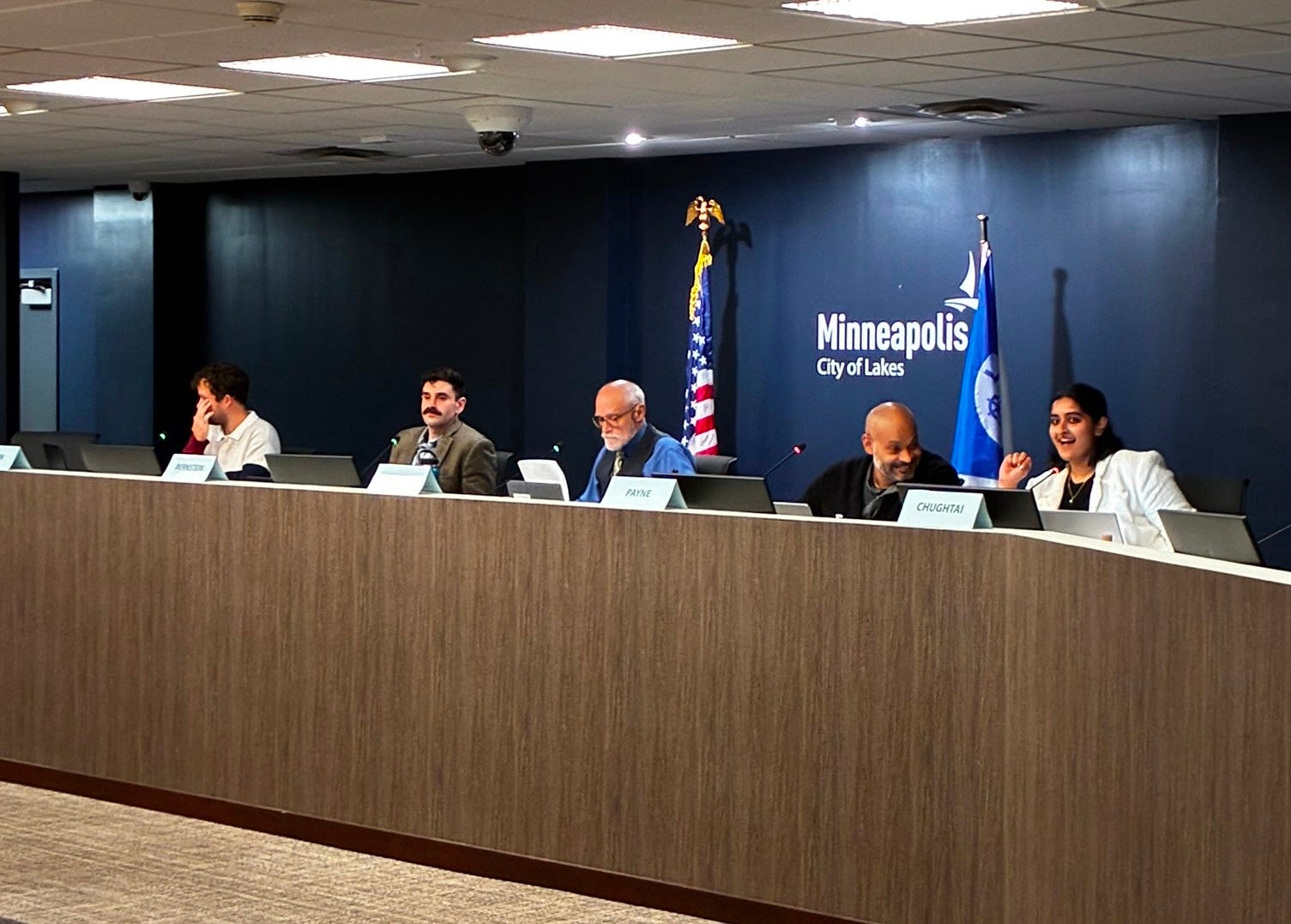
Minneapolis residents may want to start saving now for next year’s property taxes. The Board of Estimate & Taxation (BET) met Tuesday afternoon, and with no compromise reached since its last meeting, the board voted 4 to 2 to approve a maximum city levy increase of 11.3% along with the full 5.86% increase sought by the park board. Combined, the maximum levy could exceed 11.7%. [1]
Commissioner Eric Harris Bernstein introduced the amendment to fully fund both requests. “I’m offering this amendment to avoid what will be a catastrophic loss of funds, if we didn’t pass something tonight,” he said. The catastrophe he described was a return to last year’s levy, which would have happened if the board had deadlocked again.
Commissioner Mayor Jacob Frey and Commissioner Steve Brandt cast the two dissenting votes. Both held firm in wanting a lower levy. Brandt used the moment to reflect on the board’s makeup:
“I think the discussion this year has sort of pointed out the value of having a 3rd public member on this board. As the board is now constituted, city hall, whether the mayor and the council typically agree or disagree, can essentially veto any other faction of the board. And I believe that this board was set up historically so that city hall didn’t have a majority of the seats, and it operated that way until the library board was abolished, and I intend to look into the process for adding that 3rd member via referendum.”
The budget now goes to the City Council for review and amendment. The council may make cuts, which would lower the final levy, but we won’t know where it lands until mid-to-late December.
The Minneapolis Police Department’s budget is likely to face pressure. In Monday’s presentation to the budget committee, MPD acknowledged mismanagement of overtime and showcased a new dashboard it has implemented to better track overtime use. Council Member and Budget Chair Aisha Chughtai referred to that mismanagement during the BET meeting:
“I said to you over and over again, I do think there is broad ways of abuse happening inside of the Minneapolis Police Department right now, and yesterday we heard them admit that on the record, that should be concerning to every taxpayer, every resident of our city that pays into a system expecting safety, expecting help in their toughest moments, and instead to find out that a misuse of their money is happening, I think is despicable.”
Don’t Forget the Hennepin County and Minneapolis Public Schools Levies
According to Cam Gordon, writing in the new online publication Hennepin Herald, County Administrator Jodi Wentland has proposed a $2.993 billion budget that includes an 8.15% increase in total property taxes. The proposal responds to reduced state and federal funding. Public testimony included calls to maintain library service, which faces shortened hours; to expand pollution testing at the Hennepin Energy Recovery Center (HERC); and to scrutinize the Hennepin County Sheriff’s Office, whose budget has grown 30% since 2020.
Finally, there is an issue that hits close to home for many families: the Minneapolis Public Schools budget. The district is working out how to right-size a system built for 43,000 students when only 30,000 are enrolled. Its final request isn’t known yet, but we expect it will also seek an increase.
The Pinch
By some very rough math, the combined increase from the city, county, and school district levies could approach 20%. This comes at a time when gas averages $4.33 a gallon, fraud continues to surface, and many families come home from the grocery store in disbelief at what they paid.
As we discussed with Steve Brandt in our recent interview, a complicated formula determines how much each property’s taxes will change. Some owners, especially in neighborhoods where property values have risen, could see increases of as much as 20%. In 2026, 3,328 properties saw increases of more than 20%. Ward 12 had the highest median increase at 13.39%, meaning half of the ward’s properties rose by more than that and half by less.
We understand these budgets involve many competing interests. But our leaders need to do more than say they wish the increases were lower. When revenue falls, spending must fall too. Renters and homeowners alike will feel these increases. More money going to taxes means fewer nights out and less spending at local businesses. That reduces tax revenue in turn, and the cycle starts to look a lot like a recession.
[1] The MPRB levy is part of the city levy. Their portion in terms of dollars is much smaller than the city’s portion and therefore there isn’t a 1-to-1 impact on the percentage. The mayor originally proposed 2.5% “placeholder” for the MPRB increase, the additional 2.83% adds roughly .4 percent to the total city levy.


