


It would have been fitting if the monks who walked from Fort Worth, Texas, to Washington, D.C., to promote peace had been able to stop in Minneapolis along the way.
Governor Tim Walz has said he believes ICE agents will be leaving the state within days. If that proves true, the Minnesota left behind after Operation Metro Surge will be markedly different from the one federal immigration agents first encountered. For many residents, their presence has felt less like a law enforcement action and more like a natural disaster — sudden, disruptive, and terrifying.
Schools and businesses have emptied. Some storefronts are boarded up. Families are staying inside, afraid to draw attention to themselves. At the same time, neighbors have banded together, delivering food and medicine and checking in on one another. In many practical ways, people are doing what they can to protect those around them.
The bonds formed in moments like this between neighbors, friends, and like-minded residents resisting what feels like a hostile invasion are likely to outlast the operation itself. Long after the SUVs with tinted windows and obscured plates have left our streets, those relationships will remain, shaped by a shared experience of fear, solidarity, and care.
There are, of course, important differences between what Minneapolis is experiencing and a natural disaster. For one, residents are not waiting for help from the federal government. If anything, many are acting on the assumption that no help is coming. Congress is struggling to agree on basic guardrails for immigration enforcement, such as whether agents should be allowed to conceal their identities. The federal government appears paralyzed and may partially shut down.
Where the comparison does hold is in what comes next. As with any disaster, the cameras will leave. The reporters will move on. Minneapolis, meanwhile, will be left to reckon with the aftermath: an estimated $100 million carved out of the local economy, families forced to navigate the costly and painful process of reunification, and residents who have spent weeks in a state of crisis now expected to return to something resembling normal life.
Instead of federal aid, the response is coming locally. City leaders are proposing a temporary ban on evictions and would like to commit an additional $1 million toward preventing displacement. The city is shifting $500,000 from the Fire Department’s budget to fund legal defense and exploring the creation of a $5 million pool to support small businesses struggling to survive the disruption.
These measures may help, but they also underscore a stark reality: Minneapolis is being asked to absorb the costs of a federal action largely on its own. The state legislative session begins February 17, and it remains an open question whether lawmakers will deliver additional local government aid to help cities recover.
Stemming the Tide of Tyranny
We don’t pretend to know the single best way to halt what feels like a growing slide toward authoritarianism in this country. The expanding presence of ICE with its increased budget, broader mandate, and aggressive tactics is only one visible manifestation of a larger pattern.
That pattern is evident elsewhere as well: in the erosion of democratic norms, in the casual acceptance of self-enrichment and political favoritism, and in the insistence that truth itself bends to power. In a recent Atlantic essay, “Yes, It’s Fascism,” Jonathan Rauch explains why he has come to believe the term applies to Donald Trump. Central to his argument is the deliberate demolition of norms and the open glorification of force and violence as political tools.
That worldview is echoed by Trump adviser Stephen Miller, who has described politics in starkly amoral terms:
“We live in a world, in the real world, that is governed by strength, that is governed by force, that is governed by power.”
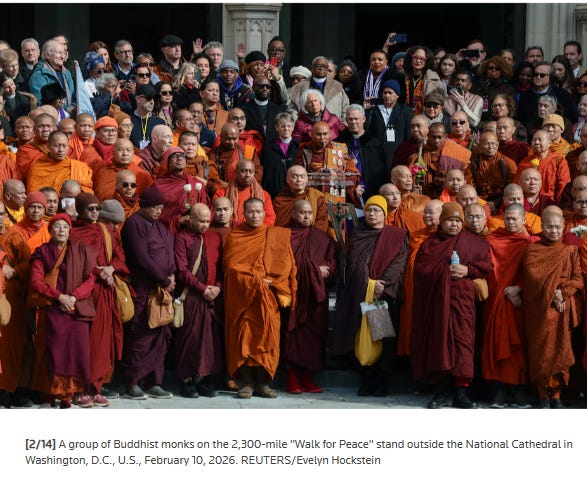
We contrast that belief — that might makes right — with the example set by the several dozen Buddhist monks who walked 2,300 miles to Washington, D.C., to raise awareness of peace, loving kindness, and compassion. Along the way, they endured extreme weather and even a tragic accident that cost one monk his leg. Their leader, Bhikkhu Pannakara, explained that the walk was not a protest, but an effort to “awaken the peace that already lives within each of us.”
At our most optimistic, we believe messages like this can still reach people who have traded compassion for the political rewards of coercion. At other moments, that optimism falters. What sustains us are the many forms of peaceful resistance already taking shape — from marches and vigils to quieter acts of solidarity, like knitting circles raising funds for local immigration aid by knitting red resistance hats like those worn by Norwegians in the 1940’s.
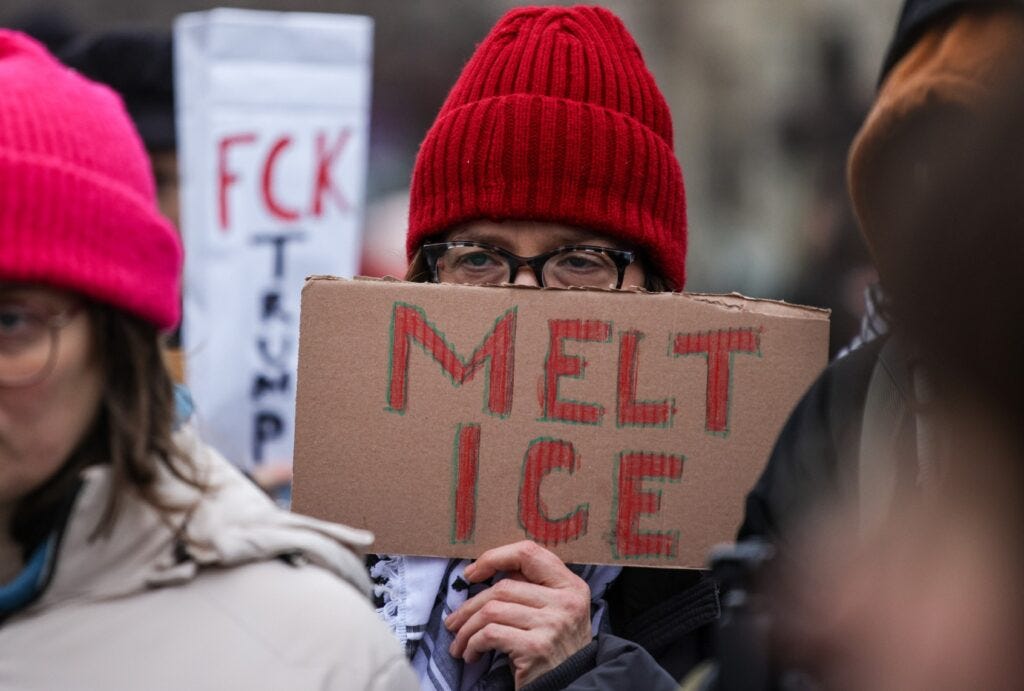
We don’t know which actions will matter most. It may be marches, music, or mutual aid, or more likely a combination of all the various tactics being used.
At a minimum, we can insist on adoption of the basic guardrails now being proposed by Democrats in the federal spending bill, including judicial warrants for home entries, visible identification for agents, a ban on masks, and meaningful local oversight. These are not radical demands. They are basic rights and reasonable limits on a federal agency that has expanded rapidly with little resistance — until it arrived in Minneapolis.


