


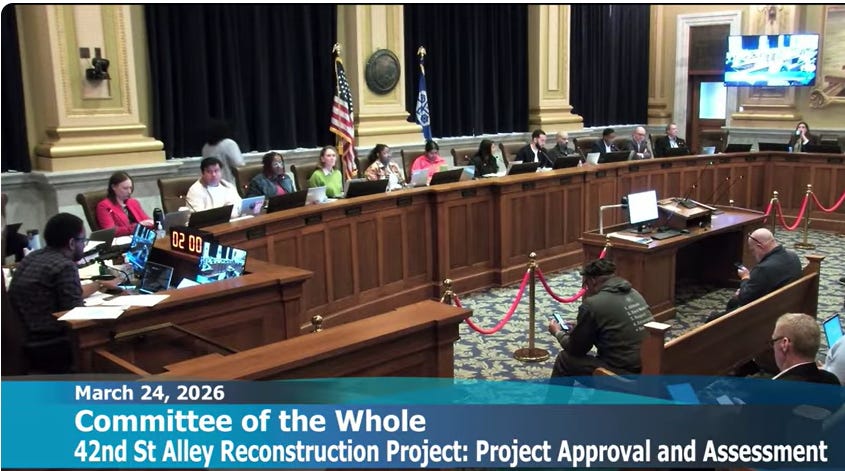
Council members, to their credit, bring notable dedication and stamina to the role. The Committee of the Whole meeting on March 24 began at 9:30 a.m. and was still going when we left for our subscriber Happy Hour at 4 p.m. Thank you to everyone who joined us. It was a lively conversation, ranging from city policy to whether meat raffle prize limits should finally be tied to inflation. We’ll see what the state legislature decides.

With the transition in Ward 5 from Jeremiah Ellison to Pearll Warren, the council now has 13 fully engaged members. They meet again Thursday, March 26, with nearly 70 items on the agenda. It’s sure to be another long session.
Several items carry real weight. Near the end is unfinished business: a proposal to extend the pre-eviction notice period from 30 to 60 days (2026-00099). The measure previously passed with support from a majority of council members aligned with or adjacent to the Democratic Socialists of America before being vetoed by Mayor Jacob Frey.
There has been a noticeable increase in social media and email outreach aimed at shaping public opinion. Much of it appears focused on council members who did not support the measure: Michael Rainville, LaTrisha Vetaw, Pearll Warren, Elizabeth Shaffer, Linea Palmisano, and Jamison Whiting, who abstained.
Further down the agenda, Item 11 (2026-00334) would authorize up to $900,000 for leadership coaching and team engagement services. In theory, this could improve collaboration between the council and the mayor’s administration—something often in short supply.
The tension surrounding the pre-eviction notice points to a broader pattern. If current dynamics hold, we’re likely to see more public-facing campaigns paired with limited behind-the-scenes consensus-building, making it harder to reach agreement on complex issues.
We’ve also seen advocacy efforts from nonprofit organizations. In one email from Inquilinxs Unidxs por Justicia, a line in all caps stood out: “OVERRIDE FREY’S CRUEL VETO.”
We don’t know Mayor Frey’s exact reasoning, but framing the veto as cruelty shifts the conversation away from policy and toward motive. Whether extending the notice period would reduce evictions is a legitimate question—one even some nonprofit housing providers have debated, with several warning of unintended consequences. That’s a discussion worth having. Assigning intent is less productive.
A lengthy discussion of a proposed Joint Powers Agreement with Hennepin County surfaced key considerations. The plan includes $1 million in rental assistance, plus $2.8 million to be matched by the Wilson Foundation. About 80% of funds would go directly to resident housing providers, while 20% would support administration through three nonprofits: Isuroon, CLUES, and the Minnesota Indian Women’s Resource Center.
Council Member LaTrisha Vetaw raised concerns about geographic representation, noting all three organizations are based in South Minneapolis and suggesting NorthPoint could better serve North Minneapolis. Council Member Osman highlighted eligibility limits: households must earn at or below 30% of Area Median Income, which is under $39,075 annually for a family of four.
Most pertinent is a practical constraint: renters need a pre-eviction notice to apply for assistance. Extending the notice from 30 to 60 days could delay when tenants can begin the process—and when aid reaches them.
That tradeoff is worth weighing before labeling the veto as “cruel.” The issue is more complex than it’s often presented, and oversimplifying it risks obscuring the real challenges facing renters who need timely support.
More on the Agenda
It’s a packed agenda. One item we’ll be watching is the proposed “safe outdoor spaces” ordinance from Council Members Chavez, Chughtai, and Chowdhury. If they’re open to it, we’d welcome them on the podcast to discuss it.
The idea has drawn opposition, but it’s worth examining on its merits. If evictions rise following Operation Metro Surge, the city could see more people experiencing homelessness this summer. Having a range of response options may prove important.
Other items raise questions about their connection to core city responsibilities.
A resolution on the normalization of relations with Cuba (2026-00303), for example, may reflect values but has no practical municipal impact.
Similarly, a resolution supporting divestment by European financial institutions from companies that enable ICE (2026-00340) appears largely aspirational. These institutions are unlikely to be influenced by actions taken by the Minneapolis City Council. If adopted, measures like this are best handled efficiently so attention can return to issues more directly affecting residents.
An item of more immediate relevance is the $18 million budget for the South Minneapolis Community Safety Center, intended to replace the former 3rd Precinct police station. The project has passed committee and, if approved by the full council, could begin construction this summer, though no completion date has been set.
Separate from that effort is a proposed $40 million Community Safety Training and Wellness Center. Item 62 (2026-00339) would authorize acquisition of the site.

Looking Ahead
Better Minneapolis will be back next Wednesday, April 1.
In the meantime, the No Kings rally is scheduled for Saturday. If you attend, we’d love to hear your perspective—send us your reactions and photos, and we may feature them in an upcoming issue.
Thanks, as always, for reading and staying engaged in Minneapolis.


