

In preparation for our interview with Ward 8 City Council Member Soren Stevenson, we put together a long list of questions. We appreciated his patience and willingness to engage on all of them, even the more controversial ones, including the rejection of Community Safety Commissioner Toddrick Barnette’s nomination, the effort to decriminalize drug paraphernalia, and overturning the ban on adult bathhouses.
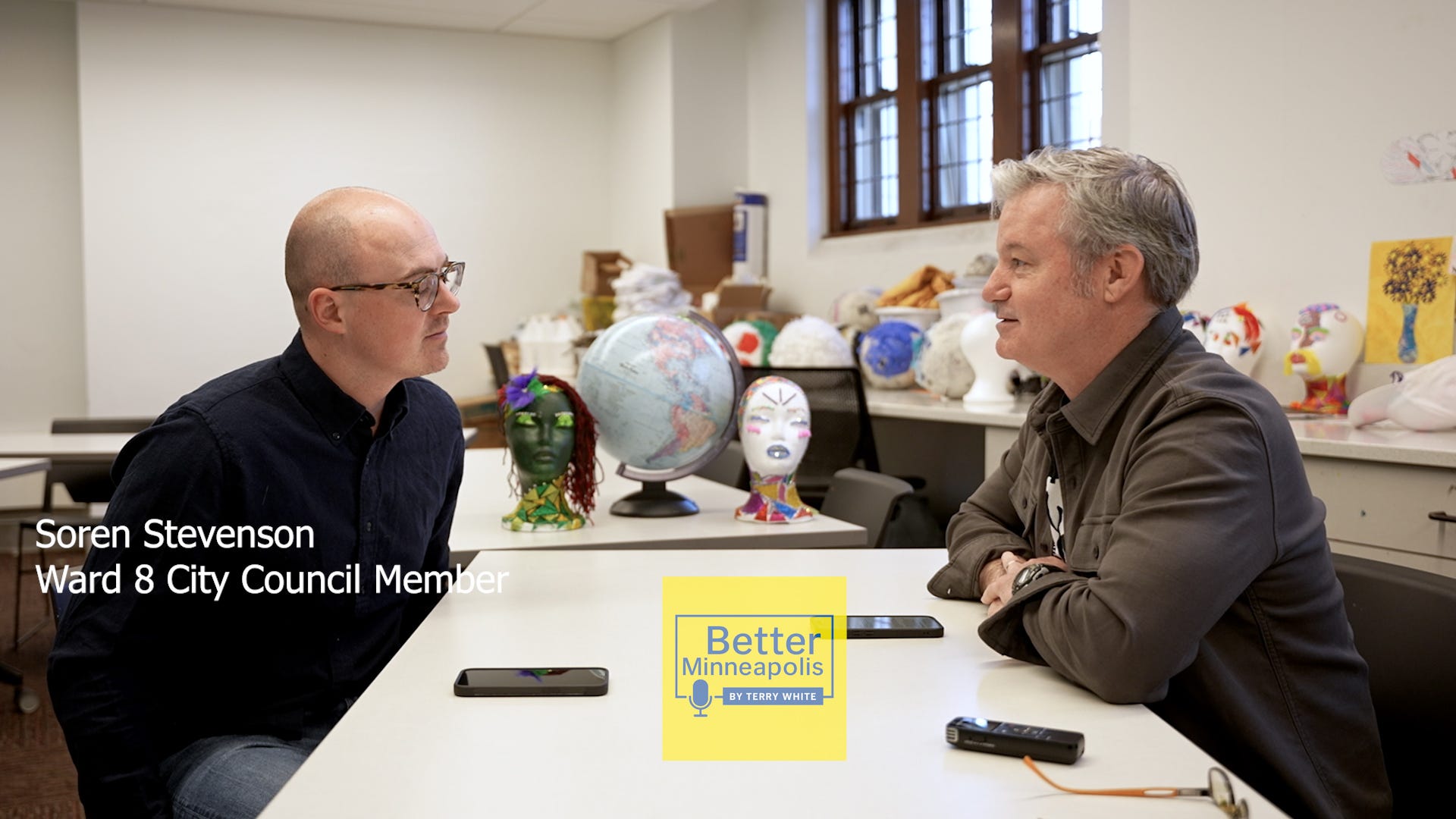
Council Member Stevenson was endorsed by the DSA and is unabashedly pro-union and pro-environment. He wants more compassion and services for people experiencing homelessness, believes more can be done on police reform, and wants to see new revenue streams for the city. Whether or not readers agree with his positions, you’ll find that he is sincere in his beliefs, and for those willing to approach him with openness, he’ll offer the same respect in return.
If you’re watching hoping for confrontation, you’ll be disappointed. That’s not our style. There are already plenty of voices out there drawing viewers with sarcasm, emotional triggers, and outrage. We are of the mindset that Minneapolis is facing serious issues, and finding workable solutions requires setting aside our own beliefs, or those of our tribe, long enough to genuinely listen. There has to be room for negotiation. We should expect our leaders to be making trade-offs: agreeing to move forward on drug paraphernalia decriminalization while tabling the bathhouse ordinance, for example, or funding road repairs in exchange for a two-year pause on the Community Safety Training and Wellness Center. These are illustrations, not recommendations, but they represent the kind of honest prioritization we’d like to see more of from the mayor and council members alike.
What’s at stake is real. We’ve seen in our own neighborhood not only how people leave the city to shop, visit the doctor, and commute to work, but how they’re choosing to move their families to the suburbs for better schools, lower crime rates, and more housing options. Constant factional battles risk accelerating that flight.

Safe Outdoor Spaces
One topic we didn’t get to in the interview was the Safe Outdoor Spaces ordinance, and we were reminded of it while driving on 4th Avenue near the Electric Fetus. About six trucks and RVs are parked along the street that appear to be people’s homes. Seeing them made us wonder whether it wouldn’t be better to have a designated place in the city where people in that situation could park, somewhere with shared facilities, water, and trash service. There are legitimate questions about such a policy: where would it go, and what happens if it becomes an open-air drug market? But those obstacles are worth working through, because the alternative is letting six beat-up RVs become twelve, until someone is shot, a fire breaks out, or there’s a drug overdose. And there’s a building nearby currently for sale that seems unlikely to attract a buyer as long as there’s a homeless encampment across the street.
Before Safe Outdoor Spaces gets dismissed as unrealistic, it would be worth holding a community forum, similar to what was done for George Floyd Square. Other cities have had success with these programs, though they may require tougher enforcement for those who don’t utilize the spaces and services provided. Council Members Chavez, Chughtai, and Chowdhury have introduced this proposal, and they have an open invitation to join us on the show. We agree with Council Member Stevenson that homelessness must be near the top of the city’s priorities, and no solution should be dismissed without sincere engagement. It’s too complicated, and the stakes are too high, to assume any one person, think tank, or nonprofit has the silver bullet.
Interview Summary
Ward 8 Council Member Soren Stevenson is three months into what he describes as a difficult but rewarding start. Beginning his term the day before Renee Good was killed on the border of his ward, Stevenson has been thrown into some of the city’s most pressing issues from day one. On the question of low-level crimes like car break-ins and auto theft, a top concern for many residents, he says the problem often involves minors, and that while police have developed more effective tactics to track perpetrators, the longer-term solution requires investment in youth programming and community supports. He draws a direct line from the collapse of those supports during COVID to the crime wave that followed, and argues the city needs to step up even where the issue technically falls under county jurisdiction.
Two major votes dominated our conversation. On the denial of Commissioner Barnette’s re-nomination, Stevenson was direct: the city’s highest-paid employee oversaw a $20 million police budget overrun and a $7 million fire department overrun, and didn’t know it was happening until the end of the year. Combined with a damning AFSCME letter citing workplace culture concerns, Stevenson said his bar for a $300,000-a-year position is simply higher. On the proposed drug paraphernalia decriminalization ordinance, which was tabled for further discussion, he pushed back on the idea that it signals tolerance for drug use. The city, he noted, is already paying organizations to do harm reduction work while simultaneously treating that work as illegal. “Which is it going to be?” he asked.
On the bigger picture of Minneapolis’s financial health and identity, Stevenson was candid about the challenges ahead. The city over-relies on property taxes compared to peer cities, revenue is shrinking while spending grows, and too many storefronts sit vacant while property owners wait for top dollar. He’s interested in tools like a land value tax and streamlining the business permitting process to make Minneapolis more attractive to entrepreneurs. On the proposed Community Safety Training and Wellness Center, he’s not opposed to the concept but clear that $40 million is the wrong spend at the wrong time when homelessness, housing, and public safety demand priority. And on Operation Metro Surge, he’s proud of the $3.8 million in rental assistance and $7 million in small business support the city has provided, but says flatly that it isn’t enough given the scale of the need.
Thank you for reading and caring about Minneapolis.
Next in our interview series: chef and restaurateur David Fhima joins us, along with three candidates on the November ballot — Matt Pelikan running for Hennepin County Attorney, Jay Reeves of the Forward Independence Party running for State Auditor, and Marion Greene seeking re-election to the District 3 County Commission.


