


Solidarity Is Fragile
At a rally marking International Women’s Day on Sunday, March 9, Minneapolis activist Nekima Levy Armstrong delivered a speech that highlighted a growing tension within Minnesota’s Democratic–Farmer–Labor Party. Her remarks reflect a broader debate in progressive politics: how movements balance calls for solidarity with strict expectations about identity and privilege.
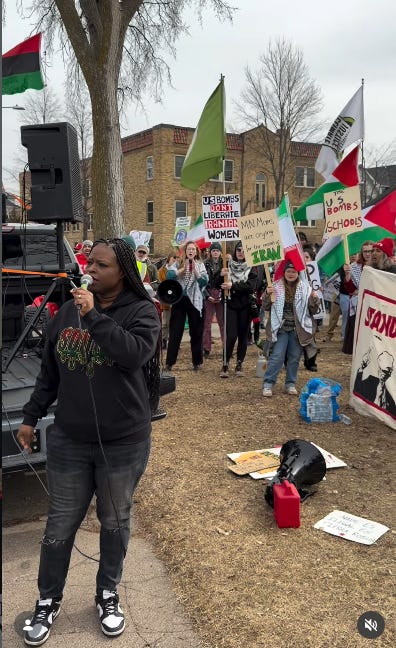
The city has shown extraordinary resilience in moments of crisis. Community members mobilized quickly when federal immigration enforcement actions threatened local families. Mutual aid networks formed overnight. Volunteers showed up to watch streets and schools, record the actions of federal agents, and to pack boxes of groceries for people afraid to leave their homes.
But once the immediate pressure fades, those coalitions sometimes turn inward. Instead of celebrating shared efforts, conversations can shift toward sorting whose contributions count the most.
Praise can become conditional. The actions of some are celebrated, while others are reminded that their efforts exist within a framework of privilege and historical injustice. A volunteer who spends two hours helping in a church basement might be asked why it wasn’t eight. Someone who donates $500 might be asked why it wasn’t $5,000. A family that opens their home to one child might be told they could have taken two.
The intention behind these critiques is often to push people toward deeper commitment. Politically, however, the effect can be something different: a coalition that becomes harder to sustain.
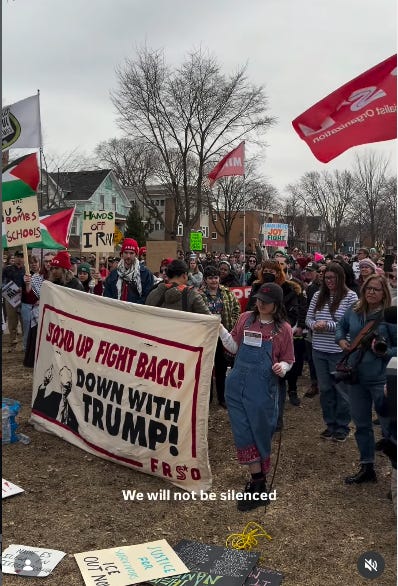
An excerpt from Armstrong’s speech illustrates the dynamic:
“We will not be silenced. We have to stand together … So, let’s continue to stand up for women. Let’s continue to stand up for immigrants. Let’s continue to stand up for our LGBTQIA community. We stand with trans women. We stand with black women, native women, Hmong women, Latinas. And white women who are genuine allies, not the ones who sell out to the patriarchy. All power to the people. Keep fighting and keep standing for what’s right. All power to the people.”
Parts of this message raise questions about how inclusive coalitions are meant to function in practice. If the goal is unity, the language introduces distinctions that can be difficult to reconcile.
For example, what determines who is seen as complicit in patriarchy and who is not? Many religious traditions are patriarchal in structure. If someone practices a religion led exclusively by men or one that places limits on women’s roles, does that make them suspect? Or does cultural background change how those dynamics are judged?
Patriarchal systems cut across religions, cultures, and ethnicities. Yet rhetoric like this often distributes criticism unevenly. The burden of confronting patriarchy falls most heavily on white women, who are warned against “selling out” but left to interpret what that means on their own. In practice, only those who successfully navigate how to live outside this system are welcomed into the coalition.
To be fair to Armstrong, this dynamic does not originate with her. Variations of this message circulate widely in activist spaces, including among white women themselves. Showing up to help is sometimes framed as the lowest possible bar. Allies are expected to demonstrate deeper commitment according to standards that are informal, ambiguous, and often shaped through social media. White women are often lectured about the need for humility and questioned about their motives. They are welcomed, but first reminded that they are late to the resistance.
What makes this dynamic striking is that the recent mutual aid efforts in Minneapolis and beyond hold the promise of greater solidarity. Thousands of volunteers—a significant portion of them white women—worked diligently in church basements, mosques, and private homes to help families afraid to leave their homes. They shopped for groceries, organized donations, and delivered supplies to people they had never met.
That kind of civic effort deserves to be celebrated without caveats. Introducing divisions based on identity risks overshadowing the very spirit of solidarity that made the effort possible.

I Have Friends Everywhere
The symbolism of resistance coalitions has surfaced in unexpected places. Recently a meme circulated online blending Minnesota’s state bird, the loon, with imagery from the Star Wars series Andor. The connection is resistance.
In the show, scattered individuals quietly working against an oppressive regime recognize one another with a simple phrase: “I have friends everywhere.”
The phrase is meant to let allies know that you are part of the resistance effort. Those involved contribute in different ways. Some take greater risks, some play supporting roles, but the movement depends on all of them.
Once movements begin narrowing membership—excluding people based on identity or perceived ideological purity—the coalition inevitably shrinks.
We were reminded of this idea while listening to an interview with writer Rebecca Solnit. She suggested it may be time for a new model of resistance—one that doesn’t rely on a single heroic figure. Instead, the model may be communities of people bound together by shared values and a commitment to a more just future. While we often look to politicians or activist leaders to act as spokespeople, the emerging paradigm may be more hive-like in nature, with no single person defining the group’s meaning.
The mutual aid effort in Minneapolis offers a glimpse of that model. Volunteers stepped forward to help families in crisis, organizing supplies and coordinating support networks. Most of them did not know one another beforehand. What connected them was a willingness to help.
That kind of civic energy is powerful. But movements hoping to translate energy into lasting change must eventually build broad political coalitions. Minnesota itself is now closely divided politically, with a legislature that often struggles to produce durable policy.
If either party hopes to enact meaningful change, it will need to expand its appeal beyond its most committed activists, especially on a national level. Winning elections—and governing effectively—requires a coalition of people who may not agree on every tenet of a platform but are willing to work together toward shared goals.
The Rebel Alliance in Star Wars succeeded not because its members were identical, but because they accepted a wide range of people willing to join the cause. Real political coalitions require the same thing: welcoming imperfect allies and recognizing that large movements are built through many different kinds of contributions.


