


Just hours before Minneapolis’ newly elected City Council convened for its first meeting, Governor Tim Walz announced he would not seek a third term. The decision immediately reshaped the state’s political landscape and underscored how volatile the moment has become.
That volatility was also evident inside City Hall. What might have been a routine organizational meeting instead revealed deep mistrust between council members. Tensions flared over committee assignments and the creation of new leadership roles, early signals that governing this term may be anything but smooth.
State of the State: Observations
Before turning to the Minneapolis City Council’s first meeting of the year, it’s worth pausing to consider what Governor Walz’s decision not to seek a third term may signal here and beyond Minnesota.
Republicans across the nation will take what’s happened in Minnesota and try to use it to their advantage in their home states. Ohio is seeing an influx of citizen fraud investigators. If Democrats thought they had a chance of picking up a Senate seat in Ohio, they can forget it. Polymarket is predicting a 61% chance that the Republican candidate, likely Vivek Ramaswamy, wins. In the last video we saw, the YouTuber who made the fraud issue a viral phenomenon was wearing a Polymarket sweatshirt. One of his sponsors appears to be the company, which makes sense, given that his videos seem capable of changing the odds and outcomes of elections.
The state DFL created a fissure when it shut down the local Minneapolis DFL. Now, it must prove its relevance across the state. How will it argue that the fraud that has been reported on — and ignored — for the last decade shouldn’t be viewed as a disqualifying factor for all of its candidates? A network of fraud proliferated in Minnesota because of many enablers within the party. If the DFL retains its current chair, Richard Carlbom, it will be a sign that the party wants to wash the windows and leave the inside in its current state. He was reportedly the one who convinced Walz he could win a third term.
Good governance requires a strong local media ecosystem. We’re witnessing many local reporters and publications defend their coverage of fraud. They are baffled by how one YouTube video could instigate the type of change that multiple reports from local outlets could not.
First, this YouTuber was categorically not “independent.” His visit was orchestrated. A more accurate description would be political operative rather than independent journalist. Second, elected DFL officials have grown accustomed to ignoring the local media and can bristle when their statements are questioned. Third, there are more layers of government in Minnesota than there are investigative reporters to cover them. There are the Hennepin and Ramsey County Boards, the Metropolitan Council, the Park Board, the state legislature, and city governments, all of which have subcommittees.
The relatively small number of people reporting on their actions means that many important decisions never see the light of day. If you want to see good government, we encourage you to support local media.
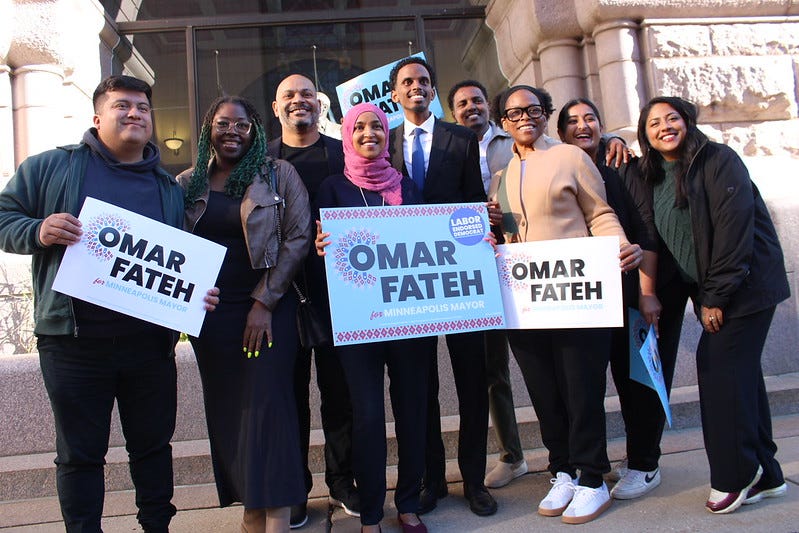
Ilhan Omar endorses Omar Fateh for mayor with Jason Chavez, Robin Wonsley, Elliott Payne, Jamal Osman, Angela Conley, Aisha Chughtai, and Aurin Chowdhury at city hall, Minneapolis (Photo: Taylor Dahlin)
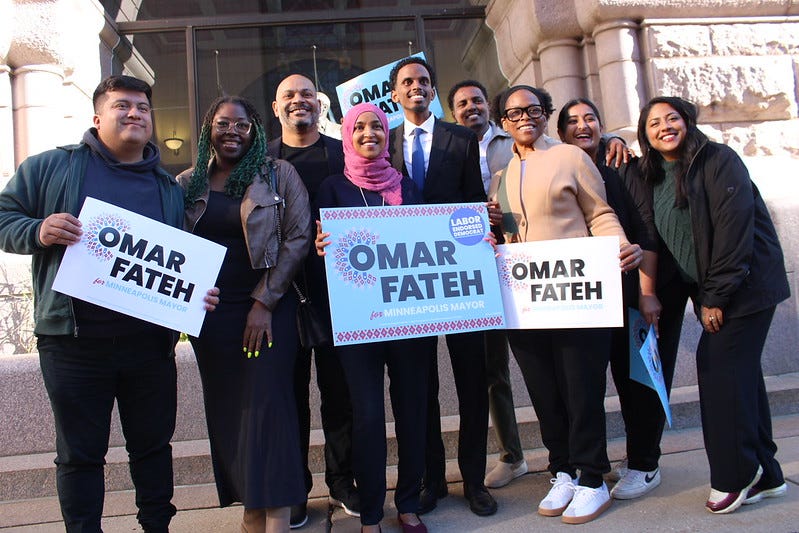
Elliott Payne Wastes No Time Asserting His Authority as Council President
The council is taking a few days to discuss priorities and goals for 2026. We hope this time will serve to reset the tone established in the opening meeting. Susan Du described it well in her Star Tribune article, “Progressive majority on Minneapolis City Council asserts control in first meeting of the year.”
As predicted, Elliott Payne was reelected as council president in an 8–5 vote. It was an early indicator that the divisions witnessed in 2025 will carry over into 2026. Proclamations of working together evaporated quickly. For reasons known only to council members, Aisha Chughtai lost her position as council Vice President and was replaced by Jamal Osman. It’s possible her public denunciation of Mayor Frey at a campaign rally played a role.
Osman’s elevation, however, is yet another sign of how little this council appears to be concerned about fraud, waste, and abuse. His connections to Aimee Bock, the transfer of his company, Stigma-Free International, to men later convicted of fraud, and the shutdown of his wife’s nonprofit due to fraud seem to be of no consequence to the voters of Ward 6 or to the majority of council members who voted him in as Vice President. Osman will chair the Business, Housing & Zoning Committee. Chowdhury will serve as vice chair.
The accusations and distrust were most evident when Payne introduced the new positions of majority and minority leader. Several council members raised questions, saying they did not understand the purpose or meaning of the new titles. It was a clear sign that more moderate members had been shut out of the deliberations. New Ward 4 council member Pearll Warren was not shy about voicing her opposition, labeling Payne’s actions as “inconsiderate.” Council Member Palmisano also voiced her misgivings, saying, “President Payne, you put the four DSA-ascribed members on everything. This is overrepresentation. I think this is a really poor start, and it shows a lack of leadership.”
Ward 7 residents will have noticed that their newly elected council member, Elizabeth Shaffer, was initially shut out of committee assignments. It took an objection vote to have her assigned as vice chair of the Budget Committee, where Chughtai will remain chair. Shaffer presented her qualifications for the committee and stated that, despite the snub, she remained committed to working with all of her colleagues. She said she did not want one meeting to dictate interactions over the next four years. We hope those intentions are not suffocated by the ambitions of her colleagues.
The role of Majority Leader was given to Chughtai in what appeared to be a conciliatory gesture after she was replaced by Jamal Osman as council vice president. The Minority Leader position was given to Wonsley, who described the role as representing city residents who voted for Democratic Socialists (DSA) candidates in the last election.
Chowdhury noted that the DSA is not an official political party in Minnesota, a distinction that will likely continue to frustrate residents until the DFL either finds a way to formally incorporate DSA-aligned members or they are compelled to form a party of their own.
Once the council settles on clear definitions for the new Majority and Minority Leader positions, we hope Council President Payne will accept our invitation to return to the podcast. Many people, both inside the newly remodeled council chamber and outside it, are curious how these roles are meant to function.
The next four years may feel very long if each council meeting is as contentious as this first one. Once again, elections have consequences. We hope the soul-searching now underway within the DFL includes a serious look at electoral reform.
If you’re interested in advertising, please contact: terry@betterminneapolis.com


