


Democrats, both nationally and here in Minnesota, have a long-standing tendency to divide and conquer themselves. That dynamic is once again on display in the debate over immigration enforcement, where slogans like “Abolish ICE” are embraced by some and viewed by others as politically damaging, especially with midterms approaching.
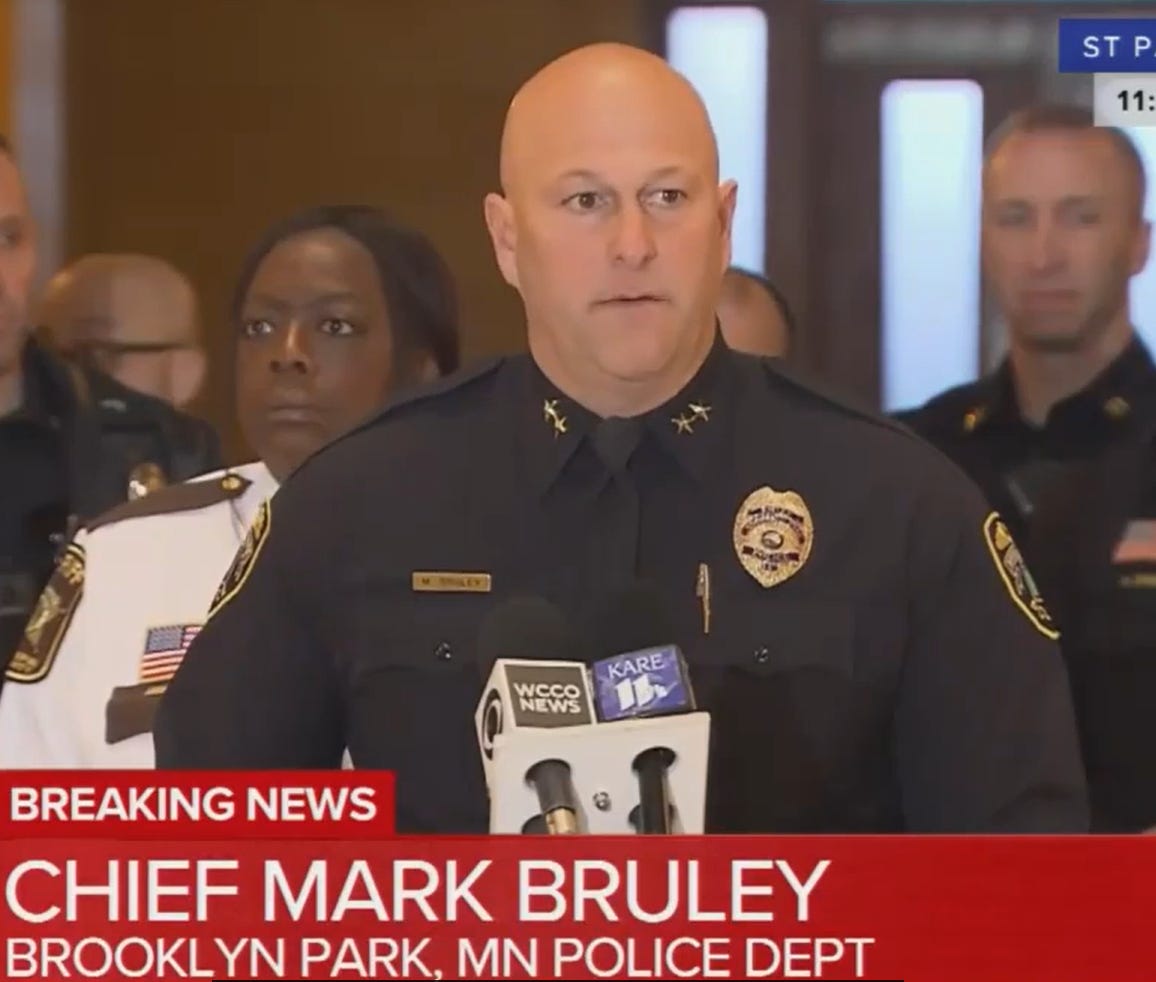
This tension surfaced locally on Tuesday, when Brooklyn Park Police Chief Mark Bruley led a press conference calling on Immigration and Customs Enforcement (ICE) to halt practices that amount to racial profiling. Officers described ICE agents stopping Black and brown residents on the street and demanding proof of legal status, tactics that have reportedly even been used against off-duty police officers. There is little dispute that such actions raise serious constitutional concerns. Documentation of these incidents has further eroded public trust in immigration enforcement and, by extension, in Republicans who defend these methods.
At the same time, Chief Bruley was careful to draw a distinction that many Democrats struggle to accept. He opened the press conference by saying:
You won’t hear rhetoric of ‘Abolish ICE’ or that there shouldn’t be immigration enforcement. The truth is, immigration enforcement is necessary for our national security and for local security. How it’s done is extremely important.
The distinction between the need for immigration enforcement and the manner in which it is carried out is where internal Democratic divisions become most pronounced. Some activists argue that ICE has become so abusive that it must be dismantled entirely, rallying behind slogans like “No one is illegal on stolen land.” Others, including many more moderate Democrats, call for reform while maintaining that immigration laws still need to be enforced. These more incremental voices are often attacked from within their own party, even as they reflect the views of a majority of Americans who support both secure borders and humane enforcement.
This divide was captured succinctly by Elaine Godfrey in The Atlantic:
A growing number of Americans disagree with how the agency is handling its mission. But where many Democrats hear “Abolish ICE” as a righteous call to action, others in the party register the clanging of alarm bells. These anxious Democrats believe that such a maximalist demand plays directly into Republicans’ hands by making the party seem unserious about immigration.
For Democrats trying to rebuild trust with swing voters and maintain a governing majority, the challenge is not whether to criticize ICE’s conduct—but how to do so without signaling that enforcement itself is off the table. On that question, the party remains deeply divided, and those divisions are increasingly visible well beyond Minnesota.

How Much Is Too Much?
The protest action that took place Sunday at Cities Church in St. Paul offers a vivid example of the fault lines running through the Democratic coalition. Some activists, including Nekima Levy Armstrong (formerly Pounds), a prominent figure in the Black Lives Matter movement, defended the action because meaningful protest is meant to make people uncomfortable. Others argued that targeting a house of worship crosses an important line. The episode highlights a lack of shared standards within the DFL-led resistance to ICE and risks eroding the goodwill that has, so far, largely favored Democrats.
This debate over tactics is not new. In his 2021 nonfiction book How to Blow Up a Pipeline, Swedish climate activist Andreas Malm challenges the near-universal commitment to nonviolence in progressive movements. Malm argues that climate change is advancing too quickly for gradual, nonviolent protest alone to avert ecological collapse. From that perspective, he contends that direct action against fossil-fuel infrastructure, such as pipelines, is morally justified given the scale of the threat and the human suffering at stake.
We’ve been thinking about Malm’s argument in light of recent social media images showing armed residents positioning themselves to deter ICE from their neighborhoods. Our opposition to this approach is both philosophical and practical. History suggests that attempting to prevent violence by threatening even greater violence rarely ends well. De-escalation has been a guiding principle in Minneapolis since the murder of George Floyd; armed standoffs with federal agents move sharply in the opposite direction.
There is also a hard political reality to consider. When confronted with the overwhelming force of the federal government, these tactics are likely to end in arrest, or worse, without generating the broader public support needed to achieve the underlying goal: changing ICE’s practices and reducing its presence. In fact, armed civilian resistance could make it easier for Trump to justify sending federal troops into the city.
Debates over protest methods are worth having. For some, throwing paint on the yachts of the ultra-wealthy to highlight environmental damage is an acceptable form of disruption; others see it as symbolic but ineffective. These disagreements mirror a larger conflict now playing out in Congress. A bipartisan funding bill would continue ICE’s roughly $10 billion budget, with the backing of Democrats who want agents to wear body cameras and receive additional training. For many on the front lines of protests in Minneapolis and elsewhere, that support feels like a betrayal. They want ICE defunded entirely.
The challenge is that these maximalist demands do not reflect a consensus view. Many Americans, including many Democrats, still believe there should be an agency responsible for enforcing immigration laws. As Chief Bruley put it, the central question is not whether enforcement exists, but how it is carried out. Until Democrats can agree on where to draw that line, internal conflicts over protest tactics risk overshadowing the very reforms they are trying to achieve.
Preparing for the Midterm Battle
On Tuesday evening, the Department of Justice announced it had subpoenaed Gov. Tim Walz, Minnesota Attorney General Keith Ellison, Minneapolis Mayor Jacob Frey, and St. Paul Mayor Kaohly Her, alleging that their public statements interfered with federal immigration operations. How local leaders respond to this development—and to the protests scheduled later this week—will matter greatly. Moments like this call for a unifying message. Fragmenting the party in an effort to force ideological purity, without agreement on shared goals, only weakens Democrats and invites Republican attacks. Internal debate is healthy, but eventually it must give way to a coherent strategy for immigration policy and for resisting the Trump administration at the ballot box.
If Democrats hope to flip the House in the upcoming midterms, they will need alignment on both tactics and messaging around ICE. Should “Abolish ICE” become the dominant message in Minnesota, there is concern that the party could see a similar loss of support to what occurred when “Defund the Police” emerged as a slogan after George Floyd’s murder. If Democrats adopt this language, they will be forced to answer difficult questions about who, exactly, is responsible for immigration enforcement and how that enforcement should function.
Minnesota’s sanctuary status already prevents state and local law enforcement from enforcing federal immigration law. It is unlikely that a majority of voters support eliminating enforcement, and even if such a position gained traction here, it would almost certainly push swing voters toward Republicans nationally. A Republican victory would be framed by Trump as an endorsement of his immigration agenda, emboldening him to escalate even further.
There is much at stake in how Minnesota meets this moment. Targeting individual ICE employees, such as the pastor at Cities Church, risks turning principled opposition to unjust policies into what looks like personal retribution. When that happens, public sentiment shifts from discomfort to outright opposition. Similarly, adopting the imagery and tactics of armed groups may energize a small base but is likely to alienate far more people than it persuades.
The anger and frustration surfacing across Minnesota are real and understandable. But if those emotions dictate strategy, any progress achieved will be fleeting. Lasting change requires building consensus around a shared objective. Allowing the loudest and angriest voices to set the tone all but guarantees a backlash that undermines the cause itself.
At the same time, there are encouraging signs. Across the state, neighbors are supporting neighbors through mutual aid efforts and acts of solidarity aimed at countering ICE’s most aggressive tactics. The question is whether Democrats can sustain and expand that goodwill or instead squander it through internal conflict. The DFL caucuses on February 3 will likely be the first real test of local alignment and may help shape Democrats’ chances of reclaiming a House majority nationally.
If the DFL hopes to contribute meaningfully to a broader Democratic wave in November, it will need to resolve its internal battles soon.
If interested in advertising, email terry@betterminneapolis.com
To message us through the Signal app, use bttrmpls.33


