


East Phillips Neighborhood Institute nears completion of Roof Depot site purchase after 12 years
After years of fits and starts, the Roof Depot project took a big step toward becoming a reality Tuesday with approval from the City Council’s Business, Housing and Zoning Committee. The next step is a sale vote by the full City Council at its Dec. 3 meeting.
Financing had sidelined this project. It now appears to have cleared that obstacle: $2 million from a 2023 Minnesota Legislature appropriation, available after closing; $4 million from a 2026 Legislature appropriation; and $120,000 in funds secured by the East Phillips Neighborhood Institute (EPNI). Dean Dovolis, principal, CEO and founder of DJR Architects and chair of EPNI, said another $10 million will be unlocked through a partnership with Cooperative Energy Futures. Once complete, the facility will host a 100,000-square-foot solar garden on its roof.
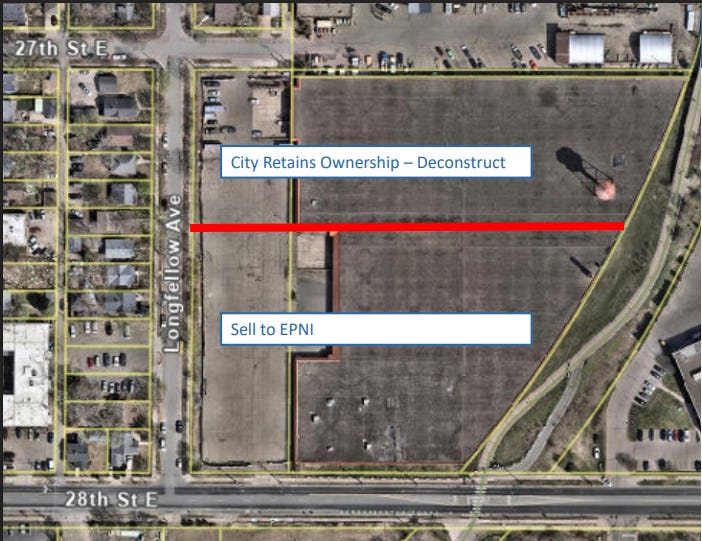
To make the purchase more affordable for EPNI, the city reduced the scope of the sale so the group buys only the southern half of the building. The city will deconstruct the north half and keep ownership of it. Its future use has not been decided. The community and DJR Architects will design the southern half.
Annual operating costs for the facility are expected to run between $10 million and $15 million. Former Ward 9 Council Member Alejando Cano was named to lead fundraising. Once construction is complete, a community organization will be formed to run operations.
Former state Rep. Karen Clark of Minneapolis was praised repeatedly for her work to make the project happen. Clark, who served in the Legislature from 1981 to 2018, died June 30, 2026. Her obituary called her “a trailblazing champion of justice and a compassionate, unwavering voice for those too often unheard.” Her wife, Jacquelyn Zita, spoke of Clark’s steadfast commitment to the project and her success in raising $6 million to make it possible.
Community members continued to fight for the project after Clark’s death. Conflicts with the city over the site’s future appear to have been resolved. Current Ward 9 Council Member Jason Chavez was instrumental in shepherding the project.
The concept of a solar garden and urban farm run cooperatively for the benefit of the community is appealing, and we hope it succeeds. However, a few parts of the project need more detail.
First, the project contract must specify that the state, not the city, is responsible for any future financial needs of the project. If annual fundraising falls short, the state must be responsible for funding operations. In 20 years, if the community has abandoned the project or the relationship with the solar provider sours, the state must step in to resolve any issues.
Second, it was unclear how the power and benefits of the project will be distributed to the local community. The community benefit model is new, and organizers hope to replicate it in other communities. First, though, the details of how it will work in East Phillips need to be worked out.
Finally, the community organization that will run the project after construction has yet to be determined. A transparent board will be critical. Until one is formed, we won’t know whether it has the skills to manage a solar farm contract and an urban farm.
Textile Artist Lofts Housing Project Sidelined
In a sign of how hard it is to build new housing right now, a request for tax-exempt housing revenue bonds to convert a former textile building at 119 Fourth St. N. was withdrawn at the same Business, Housing and Zoning Committee meeting. Rachel Benson of the city’s Community Planning and Economic Development department withdrew the request. The adaptive reuse project would have created 80 artist live/work units, affordable to households earning 60% of the area median income or less.

Benson said the developers contacted her and told her the project would not move forward because “the sustained elevated interest environment coupled with conditions in the bond and tax credit markets had created a multi-million-dollar funding gap in the capital structure.” A translation of this statement: no one wants to fund the conversion because they won’t make a profit on the project.
Council Member Elizabeth Shaffer, whose ward includes the building, asked Benson whether this project was an anomaly or part of a trend. Benson responded, “it does continue to be a challenging environment for both affordable and market rate projects due to factors like high interest rates, low tax credit project pricing, and investors expecting higher yields on returns.”
This exchange was an alarm bell. New housing, even with government subsidies, is difficult to build. Politicians who have promised new units will be challenged to deliver on those promises.
If Minneapolis and Hennepin County want to avoid further increases in homelessness and housing instability, now may be the time to consider solutions like single-room occupancy facilities, manufactured housing and tiny home villages. Rising property taxes and cuts to federal benefits such as SNAP and Medicaid could push more people to seek low-cost housing, and current conditions suggest affordable housing construction will lag behind demand.


