


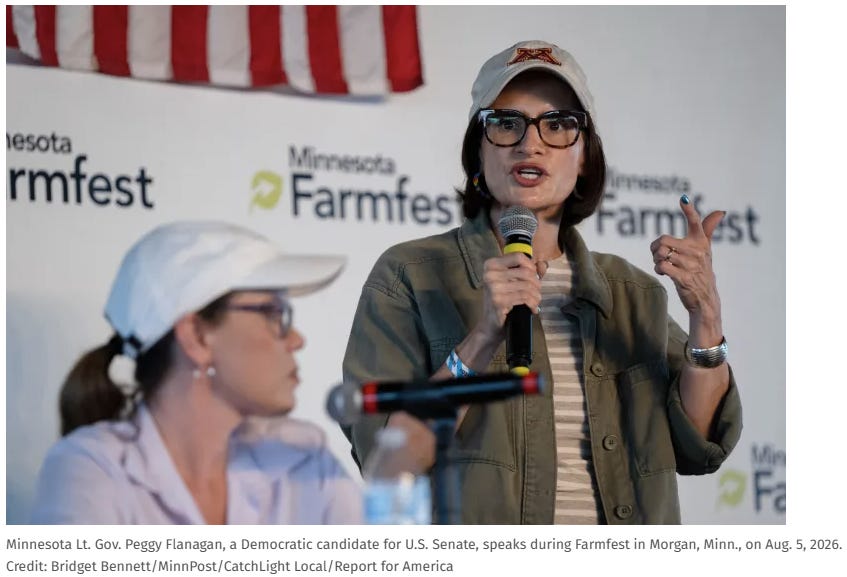
Like many readers, we’ve been assessing what Peggy Flanagan’s decisive victory over Angie Craig portends for the future of politics in Minnesota. A 20-point margin across the entire state defied conventional wisdom, which held that Flanagan would win young voters in the Twin Cities while Craig’s more practical message and record would carry outstate. Instead, Flanagan outperformed everywhere. One 19-year-old told us days before the election that Flanagan would win. When asked why, his answer was simple: “Israel.”
Lessons Learned
1. Immigration
Voting for the Laken Riley Act was a mistake Craig was unable to explain away. The vote tied her to Trump and to the trauma inflicted by Operation Metro Surge. People protested her events over it, and when she appeared before media, they asked her repeatedly to account for the vote. The race would have been much closer had she voted against the act. Flanagan used the issue like a dagger, cutting through any explanation Craig offered.
2. Bold Positions Are No Longer Intimidating
Conventional campaign wisdom held that Craig’s more centrist views would play better outstate. It now appears that even Democrats outside the Twin Cities are willing to risk a U.S. Senate seat to elect someone they see as more of an antagonist to Trump and the status quo. The level of frustration in the state runs deeper than mainstream Democratic consultants understood. Rather than timid progress on quality-of-life issues like health care, voters want bold change. Craig helped lower the cost of insulin, a real achievement, but one with limited impact on the overall market. Advocating for Medicare for All, even without a clear account of how it would work, signals the kind of major change voters are looking for.
3. Politicians Must Build Community Like Church Leaders
The DFL Party as an organization remains a vehicle for community and belonging. The party may not resemble what it was ten years ago, but like a church with a new pastor, people keep showing up for service. The Craig campaign skipped the state convention, and more importantly, it failed to grasp the importance of the camaraderie that an authentic, door-knocking, picnicking, socially engaged campaign offers, especially to younger volunteers with the time and confidence to take to the streets and social media. Craig’s campaign recalled Andrew Cuomo’s run for New York mayor: well-funded, especially by outside groups and establishment Democrats, but lacking enthusiasm in the trenches. When a consultant walks into a room full of donors with a data presentation on how the campaign can win, they drown out the voices of the many people willing to donate hours of their lives simply because they like the candidate. No amount of money replaces the neighborhood text chain, the park barbecue, or the personal social media post shared by a voter who feels compelled to get involved.
4. Do Not Accept AIPAC Money
Finally, as we saw with Abdul El-Sayed in Michigan, a Democrat cannot win in a progressive state while carrying any association with the American Israel Public Affairs Committee (AIPAC). El-Sayed ran as the anti-AIPAC candidate. Association with AIPAC proved to be a red line for progressive voters that no amount of TV advertising could wash away. MinnPost reported on April 20:
Democrats are grappling with their support for Israel, with many rejecting campaign money from pro-Israel groups and that Angie Craig is among the lawmakers caught up in her party’s shifting attitudes.
Since she first ran for Congress in 2018, Craig’s campaign has received more than $800,000 in money linked to AIPAC.
A MinnPost analysis of Federal Election Commission (FEC) filings found that of that money, $400,400 was raised through the pro-Israel group in the months before she announced her bid for retiring Sen. Tina Smith’s seat a year ago.
Summary
There are certainly other reasons for Flanagan’s victory, but we believe these are at the core. If centrist Democrats continue to run Cuomo-style campaigns that ignore or dismiss what the progressive wing of the party wants, they will keep losing primaries to candidates embracing bold ideas. Low-budget campaigns built on door-knocking, community, opposition to Trump and ICE, and distance from Israel are winning. Peggy Flanagan now represents the Minnesota DFL. The challenge ahead is for her campaign to sustain that enthusiasm, bring the Craig camp into the fold, and keep Republicans from defining her as a communist sympathizer who let fraud flourish in the state.
One point Craig raised strikes us as accurate: if Flanagan believed the Craig campaign was unfair in its advertising, she should brace for something far worse once Republicans launch their campaigns against her. As Republicans have shown again and again, there's no bottom to how low they'll go.


